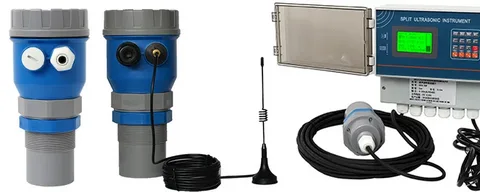
Product Overview
Ultrasonic transmitters emit high‑frequency sound waves into the process medium; the reflected signals from fluid surfaces or particles are then analyzed to produce precise measurements such as level and velocity. Because ultrasonic measurement is non‑contact, these devices are ideal for corrosive, abrasive, or high‑humidity environments common in water and sewage facilities, reducing sensor wear and minimizing maintenance requirements. Ultrasonic sensors can be configured to output standard industrial signals like 4–20 mA analog, pulse outputs, RS‑485 Modbus, or HART protocols, providing seamless integration with SCADA networks for trend analysis, real‑time alerts, and automated process actions. This flexibility allows water treatment facilities to easily integrate these sensors into existing automation architectures.
n typical applications, ultrasonic transmitters are used for tank and basin level monitoring, open‑channel flow measurement, and sludge blanket detection in clarifiers and sedimentation tanks. For example, an ultrasonic sludge level sensor provides precise readings at the interface between water and settled solids, enabling the SCADA logic to optimize clarifier operation and improve effluent quality. Their high resolution and reliability also make them suitable for raw water reservoirs, chemical dosing tanks, and overflow protection systems. The SCADA system uses these data streams to generate real‑time dashboards, historical trend graphs, automated control sequences, and alarm conditions that support efficient plant operation, regulatory compliance, and reduced manual intervention.
ABB Ultrasonic Level & Water Quality Transmitters Brochure (PDF) https://library.e.abb.com/public/1c58438a4fa345b29f709bef3c3cd589/PB_Ultrasonic%20in%20water-EN%20Rev.A%202023.04.pdf